Our craft
The product, the fire, the sharing
01
The product
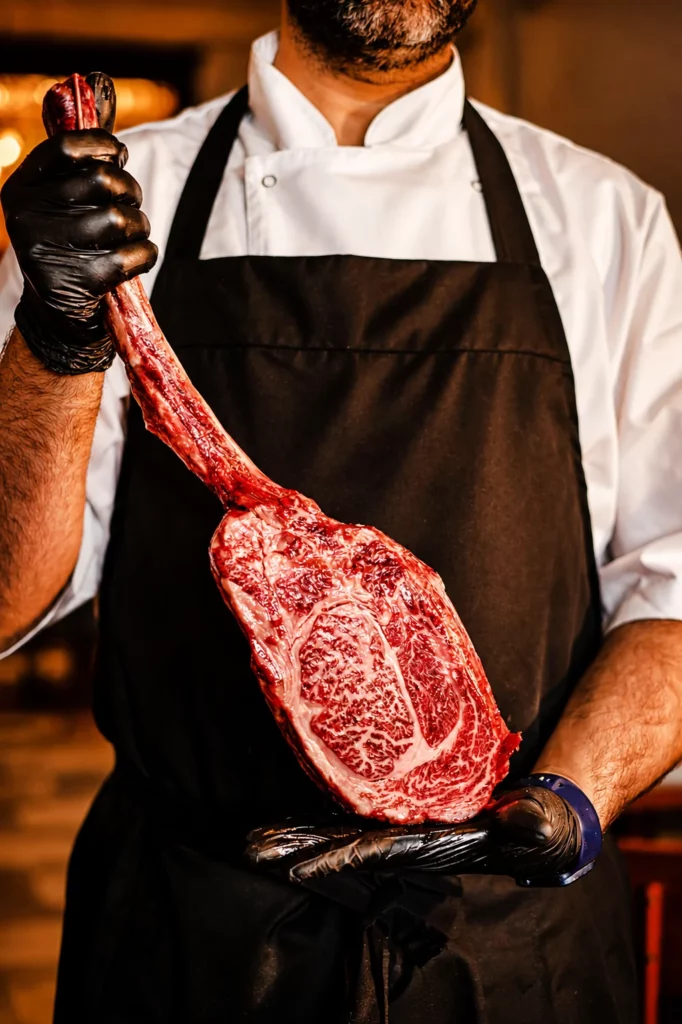
At La Ruche, everything starts with the product. Wagyu, Black Angus, Galician beef, Simmental: our meats are selected with care for their origin, marbling and tenderness.
02
Dry ageing
To bring out the full concentration of flavours, some of our exceptional meats are aged in a dehumidified, temperature-controlled environment.
03
The cooking
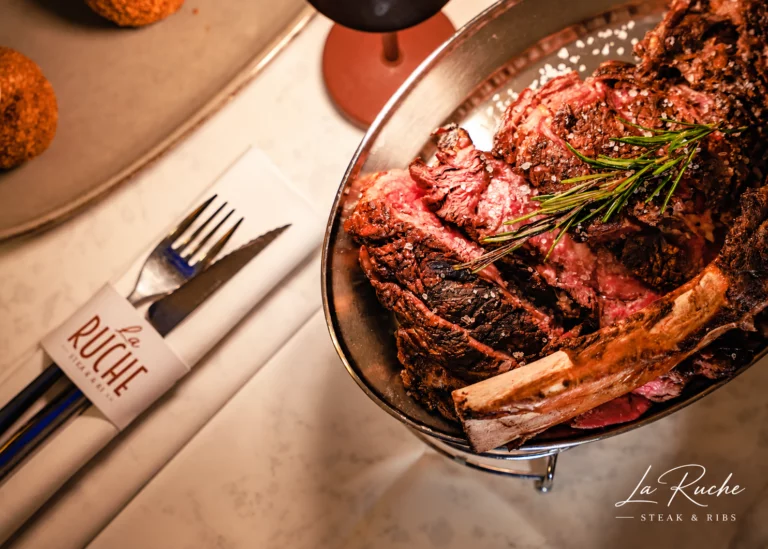
Sear, rest, serve at the right moment: cooking is a precise gesture. Our teams master the fire to bring out the best in every cut, from ribeye to tomahawk, from steaks to beef ribs.
The art of hospitality


From farm to plate
Selection, terroir, ageing, cooking, resting, service: every stage of the La Ruche Experience, explained simply.
The La Ruche Experience comes down to three words. The product: meats chosen for their breed and origin, without compromise. The fire: mastered cooking, whether searing a ribeye or slow-cooking ribs for hours. The sharing: a way of serving and welcoming that turns the meal into a collective moment.
These three pillars are not slogans. They describe, in order, the journey of a cut of meat from its selection to your table. If one is missing, the other two are not enough: the finest meat badly cooked disappoints, and the best cooking cannot save an ordinary product.
This guide details each of these stages. It is for the curious who want to understand what is on their plate, as well as for enthusiasts who want to refine their choices. You can read it in one go or open only the sections that interest you.
One clarification: the La Ruche Experience is not reserved for connoisseurs. On the contrary, it was designed so that everyone, steakhouse regular or not, feels guided and at ease.
It all starts long before the kitchen. The first stage of the La Ruche Experience is the choice of meats, and that choice begins with the breed of the animal. Each breed has its character: some give a highly marbled, melting meat, others a firmer flesh with a bold flavour.
Four families make up the range. Wagyu, of Japanese origin, is sought after for its exceptionally fine intramuscular fat. Black Angus, of Scottish origin, offers a balance between tenderness and flavour. Galician beef, from Spain, wins people over with its depth. Simmental, of Swiss origin, excels in bone-in cuts.
Offering several breeds is not a gimmick. It is a way of letting everyone find the meat that suits them, and of showing guests that there is no such thing as “beef”: there are beefs, as different from one another as two grape varieties can be.
Within the same breed, two meats can be very different. Climate, pasture, feed and the length of rearing shape the flavour as much as genetics. This is what we call terroir, and it is the second pillar of the La Ruche Experience.
The menus demonstrate it with ribeye offered from several origins: Uruguay, the United States, New Zealand, Australia or Canada, depending on the restaurant. The great grasslands of South America do not give the same meat as North American farms, renowned for their marbling, or the pastures of Oceania.
Stating the origin of each cut is a mark of respect, for the farmer and for the guest. It is also an invitation: ordering two ribeyes of different origins and tasting them side by side is still the best tasting lesson there is.
Marbling refers to the fine veins of fat that run through the muscle. During cooking, this fat melts and feeds the meat from within: it brings tenderness, juice and a large part of its aromas.
For Australian Wagyu, marbling is scored on a scale from 0 to 9+. At the highest grades, the fat traces a true lacework through the flesh.
Should you always choose the most marbled meat? No. A very fatty meat is rich: it is best enjoyed in a moderate portion. A less marbled meat offers more bite and a more direct beef flavour. The La Ruche Experience is precisely about helping you find your balance between tenderness and character.
Some exceptional meats are worth the wait. Dry ageing means letting a cut rest for an extended period in a dehumidified, temperature-controlled environment.
During this rest, two transformations take place. The muscle’s natural enzymes soften the fibres, making the meat more tender. At the same time, some of the water evaporates: the flavours concentrate, and new notes appear, often compared to hazelnut or butter.
Ageing does not suit every cut. It works best with well-marbled meats and bone-in pieces, whose fat and bone protect the flesh. That is why only certain meats are aged.
This work takes patience and rigour. It is one of those gestures invisible to the guest, but instantly recognisable on the palate.
A beef carcass offers dozens of cuts, and each has its vocation. The ribeye, taken from the rib section, is marbled and generous. The sirloin, firmer, has a tight grain. The fillet is the most tender and the leanest. The picanha, topped with its cap of fat, is the most fragrant.
The thickness of the slice matters as much as the cut. A thick piece gives a well-seared crust while keeping a pink centre. That is the whole point of the large bone-in cuts, T-bone, bone-in rib steak, tomahawk: their volume allows gradual cooking, and the bone protects the flesh.
Other cuts call for the opposite approach. Ribs and brisket, rich in collagen, would be tough on the grill. Cooked slowly, they become melting. Choosing the right method for each cut: that is the heart of the craft.
Cooking is the moment when everything is decided. A cut patiently selected and aged can be elevated or ruined in a few minutes.
The principle of grilling is the sear: in contact with very high heat, the surface of the meat browns and develops grilled aromas, while the inside stays juicy. That tasty crust is the signature of a successful steak.
The whole art lies in judgement. Too little heat, and the meat cooks without colouring. Too long, and it dries out. So the cook adapts to each cut: its thickness, its marbling, the cooking requested.
In the La Ruche Experience, you are always asked how you would like your meat cooked, and the team tells you what shows the cut at its best: rare for lean meats, medium for the most marbled.
It is the least known stage, and one of the most important. Straight off the grill, a meat is not ready to be served. Under the effect of the heat, its juices have gathered in the centre of the cut.
A few minutes of rest let them spread back through the fibres. The meat relaxes, its temperature evens out, and it keeps its juice when sliced, instead of losing it on the plate.
The thicker the cut, the longer the rest. A tomahawk rests far longer than a sirloin. That is also why a large cut calls for a little patience at the table: this waiting time is part of the quality.
An exceptional meat does not take well to artifice. That is why seasoning, in the La Ruche Experience, comes down to very little: salt, sometimes pepper, a fresh herb such as rosemary or thyme, and the flame.
Salt plays the leading role. It lifts the natural taste of the beef and helps form the crust during searing. It is all a matter of timing and quantity: added too early and in excess, it dries the surface; added just right, it underlines without dominating. A pinch of fleur de sel when serving also adds a light crunch.
Pepper, for its part, dislikes high heat: it is better ground at the end, to preserve its fragrance. As for herbs, they are often placed on the hot cut or passed through the flame, so their essential oils spread without burning.
Marinades and glazes are reserved for the meats that call for them: ribs and brisket, whose slow cooking goes well with sweet or spicy barbecue sauces. For a Wagyu ribeye or a Galician beef rib, on the other hand, the rule is restraint.
Keep this principle in mind for your own cooking: the finer the product, the less you should do to it. It is one of the simplest, and most demanding, convictions of the house.
La Ruche is a steakhouse, but also a house of ribs. And ribs are a completely different discipline from grilling.
Here, there is no lightning sear: the cooking is long, gentle, steady. Hour after hour, the collagen in the meat melts and the flesh becomes so tender that it comes away from the bone. The ribs are then glazed with sauce and finished over the flame, to caramelise the surface.
Several recipes are on offer depending on the restaurant, including Honey & Barbecue and Hot & Spicy. Brisket, beef breast cooked for a very long time, belongs to the same family.
Mastering both high heat and slow cooking is what makes the La Ruche Experience unique: two schools, two textures, one standard.
A fine cut deserves a fine entrance. Large cuts are presented whole, then sliced: every guest sees the cooking, the colour of the centre, the sheen of the crust.
Some preparations are finished in the dining room, over the flame. The gesture is not just a show: it warms the surface, melts the fat and releases the aromas at the exact moment of tasting.
Sharing is at the centre of everything. Boards placed in the middle of the table, sides to pass around, sauces served separately: the meal is built together. This is what the house calls the art of hospitality.
In a steakhouse, sides have a precise role: to support the meat without stealing the show. So the menu stays deliberately simple.
Homemade fries come classic, with parmesan or as sweet potato fries. Homemade mash comes plain or with truffle. Baby potatoes with thyme, seasonal vegetables and green salad complete the choice.
A tip: with a highly marbled meat, choose a fresh side, salad or vegetables, which lightens the meal. With a leaner cut, mash or fries bring the indulgence.
Sauces are offered on the side. Always taste the meat plain first: an exceptional cut, well cooked, often needs nothing more than a little salt.
A steakhouse is sometimes reduced to its grills. Yet the La Ruche Experience begins with the starters, and they already say a lot about the care given to the product.
The Wagyu carpaccio is the best example: very thin slices, served raw, where nothing hides the quality of the meat. The homemade croquettes, crisp on the outside and melting inside, bring a Belgian touch. The burgers offer a more relaxed way of tasting the great origins.
These dishes have one thing in common: they are made for sharing. Ordering several starters for the table is an excellent way to open the meal, and to give everyone time to choose their main cut.
Desserts follow the same logic. Brioche French toast, crème brûlée, a warm chocolate fondant: generous recipes that end the La Ruche Experience on a comforting note. The house mocktails, fresh and fruity, accompany it all from start to finish.
We are often asked how to cook a good steak at home. Here are a few simple principles, inspired by the La Ruche Experience.
Take the meat out of the fridge a little while before cooking, so it is not ice-cold in the centre. Dry it carefully: a damp surface will not colour.
Heat your pan or grill until very hot before putting the cut on. Do not move it while it sears, and do not pierce it: turn it with tongs.
Salt at the last moment or just after cooking. Always let the meat rest for a few minutes under a sheet of foil before serving.
Finally, choose a fine, fairly thick cut from a butcher you trust. No technique makes up for a mediocre product: that is the first lesson of the house.
Do I need to know about meat to enjoy the La Ruche Experience? No. The team is there to guide you: simply tell them what you like, a melting meat or one with more character, and they will suggest the right cut.
Are all the meats aged? No, only certain exceptional meats are. Ageing works best with well-marbled cuts and bone-in pieces.
What is the best cooking? There is no single rule. Rare suits lean cuts, medium suits highly marbled meats. If in doubt, follow the team’s recommendation.
What should I choose if I do not like rare meat? Go for the ribs: their slow cooking gives a meat that is cooked through yet very melting.
Can we enjoy the La Ruche Experience as a group? That is the best way. The large cuts are designed to be shared by two, three or more.
Where can I enjoy the La Ruche Experience? In our four restaurants, in Brussels, Antwerp and Marrakech.
Reading is no substitute for tasting. The La Ruche Experience is lived in our four restaurants: La Ruche Atomium and La Ruche Saint-Gilles in Brussels, Le Petit La Ruche in Antwerp and La Ruche Marrakech.
For a first visit, we suggest putting together a meal that tells the whole story: a starter to share, a grilled cut of the origin of your choice, a portion of ribs in the centre of the table and a dessert.
Do not hesitate to ask the floor team about origins, ageing or cooking. They will be delighted to answer: passing on this craft is part of our job.
Book your table at the restaurant of your choice from the “Restaurants” page, and discover the menus on “The Menu” page.
The La Ruche Experience does not stop at the restaurant door. The house regularly shares what goes on behind the scenes on social media: deliveries, butchery, cooking, flambéing in the dining room and new dishes.
Find these images on the La Ruche Atomium Instagram account, as well as on the accounts of each of our addresses. It is a good way to discover the cuts of the moment before booking, or to see again the tomahawk that made an impression on you.
Would you like to treat someone to the La Ruche Experience? Book a table in their name at the restaurant of your choice and let the team know: they will make the moment special.
Finally, if you have lived the La Ruche Experience and would like to share your impressions, talk to the team on site. Your feedback matters: it helps us refine, day after day, the selection, the cooking and the welcome.
Product, fire, sharing: three simple words, and a lot of work behind each one. That is everything the La Ruche Experience stands for, and it is what we invite you to come and taste.
Live the experience
Legal notice
Privacy
Cookies
